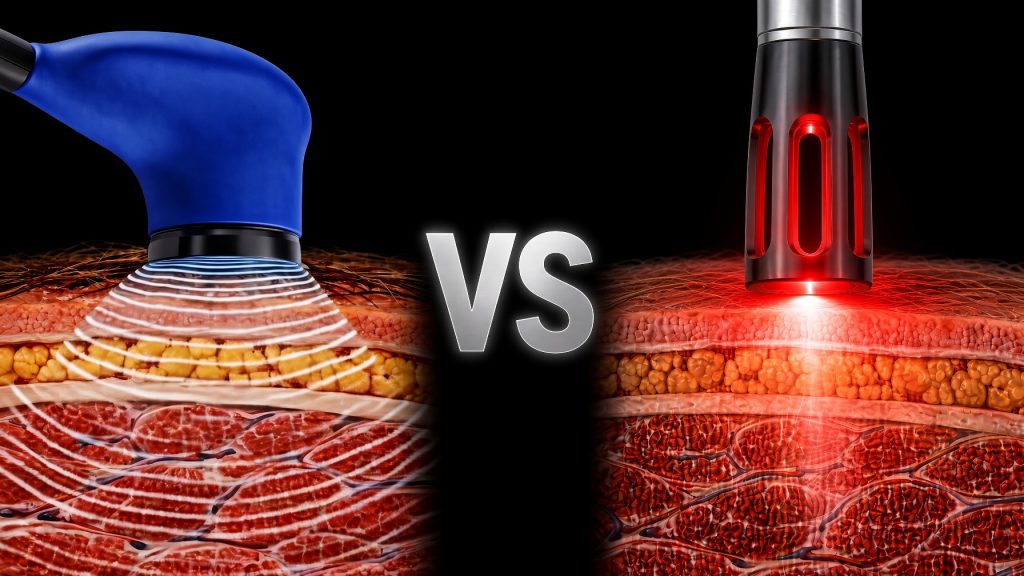
Why choose low-frequency ultrasound when you already have a Class IV laser?
.
Class IV laser therapy (also called class 4 laser therapy) delivers light energy through photobiomodulation, influencing cellular signaling, inflammation, mitochondrial activity and pain. [1]
EQ Pro Therapy delivers 38-kHz low-frequency ultrasound, producing mechanical acoustic energy within tissue.
Therapeutic ultrasound is an established veterinary rehabilitation modality for muscle, tendon and ligament injuries, scar tissue, fibrosis, edema and postoperative rehabilitation. [2]
Laser uses light. EQ Pro uses sound. This fundamental difference means the two technologies interact with equine tissue differently.
The question is not which technology is “better.”
It is whether EQ Pro Therapy can provide additional treatment capabilities for your equine patients.
What EQ Pro Low-Frequency Ultrasound Adds to Your Equine Practice
1. Low-frequency ultrasound can deliver energy deeper into tissue
.
Light is strongly scattered and absorbed by biological tissue. One study of commercially available near-infrared laser therapy devices found that more than 90% of the initial energy was absorbed within the first 10 mm, with very little remaining at 15–20 mm. [3]
Low-frequency ultrasound behaves differently: acoustic energy can propagate through soft tissue with less attenuation and reach deeper structures. [4]
For deeper musculoskeletal tissues, low-frequency ultrasound therapy can therefore deliver acoustic energy beyond the depth where much of the optical energy from an infrared Class IV laser has been attenuated.
2. Equine-specific consideration: coat and pigmentation affect laser delivery
.
In an equine study, Class IV laser therapy produced greater skin surface heating in non-clipped horses than in clipped horses, demonstrating that the hair coat influences laser energy absorption. [5]
A separate equine study found that hair and skin pigmentation, tissue thickness and wavelength affected laser penetration, while clipping or shaving improved transmission to the superficial and deep digital flexor tendons. [6]
For equine patients, this means the optical energy reaching a target can vary between horses, and clipping may not always be desirable for competition or show horses.
EQultrasound Pro Therapy is not affected by melanin or hair pigmentation; its transmission is governed primarily by the acoustic properties of the tissues.
3. EQ Pro provides mechanical stimulation
.
EQ Pro Therapy delivers mechanical acoustic energy into tissue. At 38 kHz, low-frequency ultrasound produces mechanical vibration, cavitation, acoustic streaming and microstreaming — effects distinct from the photobiomodulation of a Class IV therapeutic laser. [4,7]
These effects may be relevant to muscle, tendon and ligament injuries, scar tissue, fibrosis, edema and postoperative rehabilitation, supporting tissue mobility and the remodeling of scar and connective tissue. [2]
Experimental research has also shown effects of low-frequency ultrasound on fibroblast proliferation and collagen type I expression, supporting its potential role in tissue repair and remodeling. [8]
EQ Pro Therapy therefore provides a mechanical treatment approach that Class IV laser therapy cannot provide.
4. Thermal effects
.
Class IV laser therapy can increase tissue temperature; however, laser heating is influenced by the absorption of light in the hair, skin and underlying tissues. [5,9]
Low-frequency therapeutic ultrasound can also generate controlled heating within tissues when continuous-emission transducers are used. Unlike laser therapy, ultrasound is not constrained by optical absorption in hair and pigmented skin, allowing thermal effects to be produced through acoustic energy within the tissues. [4]
5. Sonophoresis: A Unique Capability of Low-Frequency Ultrasound
.
Low-frequency ultrasound can increase tissue permeability and facilitate transdermal delivery of drugs or homeopathic substances through sonophoresis, with cavitation playing an important role. [10]
EQ Pro Therapy enables ultrasound-assisted transdermal delivery—a capability not provided by Class IV laser photobiomodulation.
6. What Does Class IV Laser Therapy Do Well?
.
Class IV laser therapy has established clinical applications, providing photobiomodulatory effects and supporting treatment of pain, inflammation, musculoskeletal conditions and tissue repair. [1]
In a randomized equine study, an 808/980-nm Class IV therapeutic laser significantly improved pain, swelling and lameness in horses with tendon and ligament injuries, with reported analgesic and anti-oedema effects; however, no significant improvement in lesion echogenicity was observed. [11]
Analgesia is an important distinction: EQ Pro Therapy is not an analgesic modality and does not mask pain. Its effects are mechanical and thermal rather than analgesic.
For veterinarians, this represents two different therapeutic approaches: pain modulation with Class IV laser therapy and mechanical tissue stimulation with low-frequency ultrasound.
7. Class IV Laser Therapy Requires Additional Safety Considerations
.
Class IV lasers present an immediate eye hazard from direct and reflected laser exposure, posing a risk of eye injury to both the operator and the patient. Because of these ocular risks, protective eyewear is used for both the operator and the horse during Class IV laser treatment, as documented in published equine studies. [11]
The FDA also identifies skin and potential fire hazards associated with Class IV lasers. [9]
High-powered lasers can also produce significant thermal effects and require careful application. [12]
FDA guidance states that Class IV laser devices should be used by appropriately trained personnel. [9]
EQ Pro Therapy does not use laser radiation. No laser beam, no risk of laser-induced eye injury to the operator or patient, and no laser goggles required.
8. Published equine evidence for 38-kHz EQ Pro Therapy
.
EQ Pro Therapy has been studied in equine patients. In one study involving 23 sport horses with suspensory-ligament injuries, 20 horses were reported to benefit from treatment, with 87% returning to competition after EQ Pro therapy and rehabilitation. The treatment was well tolerated and required no sedation. [13]
Research has also examined EQ Pro Therapy in eight horses with painful, atrophied shoulder muscles. After 10 treatments, horses showed significant improvements in muscle cellular health, efficiency, coordination and force production, with these benefits maintained through the six-month follow-up. [14]
The evidence for low-frequency ultrasound therapy extends beyond equine applications. A systematic review and meta-analysis of eight randomized controlled trials found evidence supporting its use as an adjunctive treatment for chronic wound healing. [15]
9. Portability matters in equine practice
.
EQ Pro Therapy weighs just 11 lb (5 kg), including the battery, and can be worn like a backpack during treatment, allowing the veterinarian to move freely around the horse.
In equine practice, portability is more than convenience—it allows greater freedom of movement and can contribute to safer handling during treatment.
The key differences
.
Laser delivers photobiomodulation. EQ Pro Therapy delivers mechanical acoustic stimulation.
Class IV laser and low-frequency ultrasound are not interchangeable technologies. Laser can be valuable for pain modulation and photobiomodulation.
With EQ Pro Therapy, you can access:38-kHz low-frequency ultrasound
- Mechanical stimulation, cavitation and acoustic streaming
- Thermal effects
- Sonophoresis
- No analgesic effect
- Portable, battery-powered operation
EQ Pro Therapy adds therapeutic capabilities that Class IV laser therapy does not provide.
Two different technologies. More therapeutic options for your equine practice and your patients!
Also using focused shockwave therapy?
See how focused shockwave therapy differs from EQ Pro low-frequency ultrasound
References
- Millis DL, Bergh A. A Systematic Literature Review of Complementary and Alternative Veterinary Medicine: Laser Therapy. Animals. 2023;13(4):667. doi:10.3390/ani13040667.
- Watson T, Levine D. Therapeutic Ultrasound. In: Millis DL, Levine D, eds. Canine Rehabilitation and Physical Therapy. 2nd ed. Elsevier; 2014:328-341. doi:10.1016/B978-1-4377-0309-2.00019-3.
- Kaub L, Schmitz C. More than Ninety Percent of the Light Energy Emitted by Near-Infrared Laser Therapy Devices Used to Treat Musculoskeletal Disorders Is Absorbed within the First Ten Millimeters of Biological Tissue. Biomedicines. 2022;10(12):3204. doi:10.3390/biomedicines10123204.
- Bader KB, Padilla F, Haworth KJ, et al. Overview of Therapeutic Ultrasound Applications and Safety Considerations: 2024 Update. J Ultrasound Med. 2025;44(3):381-433. doi:10.1002/jum.16611.
- Zielińska P, Soroko-Dubrovina M, Śniegucka K, Dudek K, Čebulj-Kadunc N. Effects of High-Intensity Laser Therapy (HILT) on Skin Surface Temperature and Vein Diameter in Healthy Racehorses with Clipped and Non-Clipped Coat. Animals. 2023;13(2):216. doi:10.3390/ani13020216.
- Duesterdieck-Zellmer KF, Larson MK, Plant TK, Sundholm-Tepper A, Payton ME. Ex vivo penetration of low-level laser light through equine skin and flexor tendons. Am J Vet Res. 2016;77(9):991-999. doi:10.2460/ajvr.77.9.991.
- Mei L, Zhang Z. Advances in Biological Application of and Research on Low-Frequency Ultrasound. Ultrasound Med Biol. 2021;47(10):2839-2852. doi:10.1016/j.ultrasmedbio.2021.06.005.
- Hormozi Moghaddam Z, Mokhtari-Dizaji M, Nilforoshzadeh MA, Bakhshandeh M. Ultrasound Waves Effect on the Proliferation of Fibroblast Cells: Collagen Type I Expression. J Biomed Phys Eng. 2025;15(3):249-262. doi:10.31661/jbpe.v0i0.2212-1567.
- U.S. Food and Drug Administration. Frequently Asked Questions About Lasers. FDA. Accessed September 2, 2026.
- Mitragotri S, Kost J. Low-frequency sonophoresis: a review. Adv Drug Deliv Rev. 2004;56(5):589-601. doi:10.1016/j.addr.2003.10.024.
- Zielińska P, Nicpoń J, Kiełbowicz Z, Soroko M, Dudek K, Zaborski D. Effects of High Intensity Laser Therapy in the Treatment of Tendon and Ligament Injuries in Performance Horses. Animals. 2020;10(8):1327. doi:10.3390/ani10081327.
- Soroko-Dubrovina M, Zielińska P, Dudek KD, Śniegucka K, Nawrot K. Thermal Effects of High-Intensity Laser Therapy on the Temporomandibular Joint Area in Clinically Healthy Racehorses-A Pilot Study. Animals. 2025;15(10):1426. doi:10.3390/ani15101426.
- Carrozzo U, Toniato M, Harrison A. Assessment of Noninvasive Low-Frequency Ultrasound as a Means of Treating Injuries to Suspensory Ligaments in Horses: A Research Paper. J Equine Vet Sci. 2019;80:80-89. doi:10.1016/j.jevs.2019.07.007.
- Isbell D, Laguna S, Harrison A. A Static Bioimpedance and Dynamic Acoustic Myography Preliminary Assessment of Low Frequency Therapeutic Ultrasound Treatment of the Shoulder Muscle Trapezius: An Equine Study. Open J Vet Med. 2021;11(4):125-135. doi:10.4236/ojvm.2021.114008.
- Voigt J, Wendelken M, Driver V, Alvarez OM. Low-frequency ultrasound (20-40 kHz) as an adjunctive therapy for chronic wound healing: a systematic review of the literature and meta-analysis of eight randomized controlled trials. Int J Low Extrem Wounds. 2011;10(4):190-199. doi:10.1177/1534734611424648.