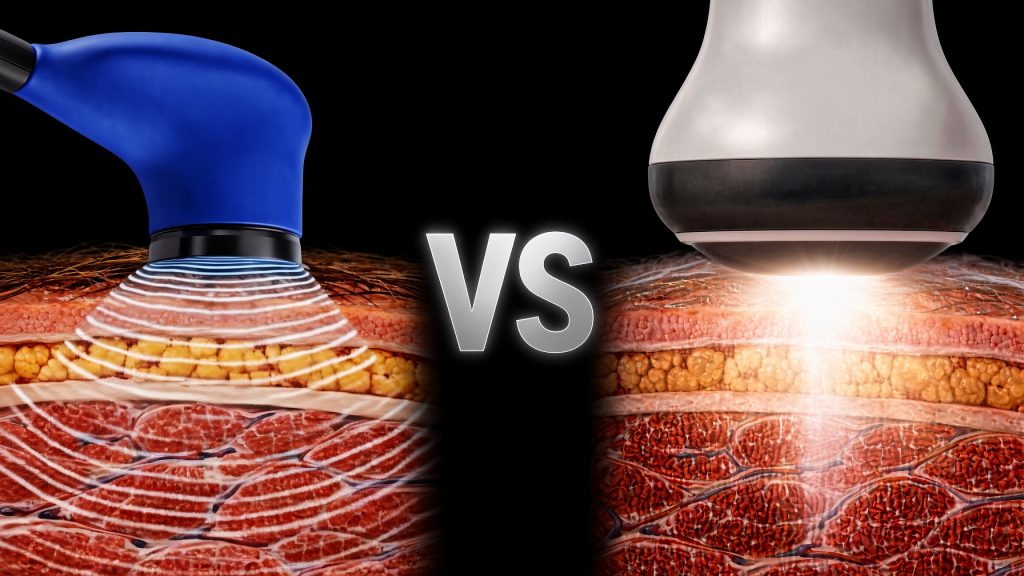
Why add EQ Pro if you already use focused shockwave therapy?
.
Focused shockwave therapy is a valuable tool in equine sports medicine, delivering high-energy acoustic pressure pulses concentrated at a focal target. EQ Pro Therapy provides something different: 38-kHz low-frequency ultrasound that delivers mechanical acoustic energy with cavitation, acoustic streaming and thermal effects. It also offers ultrasound-specific capabilities such as sonophoresis. [1,2]
The question is not which technology is “better.”
It is what additional treatment possibilities low-frequency ultrasound can bring to your practice.
What Can EQ Pro Add to Your Practice?
1. Low-frequency ultrasound: a different acoustic stimulus
.
EQ Pro operates at 38 kHz. At low frequencies, ultrasound can produce cavitation, acoustic streaming and microstreaming—mechanical effects fundamentally different from the high-energy focal stimulus used by ESWT. [1,2]
Therapeutic ultrasound is routinely described in veterinary rehabilitation references for managing muscle, tendon and ligament injuries, joint contracture, scar tissue, fibrosis, edema, postoperative rehabilitation and chronic soft tissue dysfunction. [3]
For equine veterinarians treating a wide range of orthopedic and rehabilitation cases, this versatility increases equipment utilization and return on investment.
The highest-energy acoustic treatment is not automatically the best treatment for every tissue, every indication or every horse.
2. Thermal effects
.
Therapeutic ultrasound can produce also thermal effects, when appropriate continuous-emission transducers are selected. [3]
This gives the veterinarian a treatment mechanism fundamentally different from the high-amplitude pressure pulses of ESWT.
With EQ Pro, mechanical and thermal treatment strategies can be selected according to the clinical objective.
3. Sonophoresis: an additional capability
.
Low-frequency ultrasound can increase tissue permeability and facilitate the transdermal delivery of drugs or homeopathic substances —a process known as sonophoresis. Cavitation is an important mechanism in low-frequency sonophoresis. [4]
EQ Pro can therefore provide ultrasound-mediated sonophoresis—something shockwaves cannot.
4. Treat more than a single focal target
.
Focused shockwaves concentrate energy around a selected focal zone.
EQ Pro can instead treat a broader anatomical area, making it useful when the veterinarian wants to address a larger region of muscle or soft tissue rather than a single focal point.
This broader treatment capability can be particularly useful in equine rehabilitation, where injuries rarely occur in isolation. [3]
Focused shockwaves ➔ Target the focal lesion
EQ Pro Therapy ➔ Treat the region
Having both approaches available gives the veterinarian more options.
5. A different treatment experience for the horse
.
Focused shockwave therapy delivers a substantially more intense acoustic stimulus and can cause discomfort during treatment as well as temporary soreness afterward. In equine practice, ESWT often requires standing sedation and patient restraint to facilitate a safe treatment session. [5]
EQ Pro Therapy allows gentler, repeatable sessions that provide cumulative mechanical stimulation and can be incorporated into an ongoing equine rehabilitation program. This approach may be useful when the treatment goal includes:
- tissue remodeling and gradual repair
- collagen and scar-tissue remodeling
- improving tissue extensibility
- increasing local circulation
- reducing edema
Low-frequency ultrasound is generally well tolerated by horses, and published EQ Pro research reports that treatment does not require sedation. [6,7]
EQ Pro is also very quiet. Unlike ESWT, it does not produce the loud, ballistic noise associated with focused shockwave therapy and does not require hearing protection as part of the treatment protocol. [5]
EQ Pro does not produce the analgesic effect associated with ESWT. Shockwave-induced analgesia can persist for several days after treatment and may temporarily mask pain, potentially allowing a horse to exercise before the injured tissue is ready. This is recognized as an important concern for the safety of the horse and rider and one of the reasons for restrictions on ESWT use close to competition. [5]
Well tolerated. No sedation. Quiet. No analgesic effect.
6. Published EQ Pro Therapy evidence in horses
.
Published studies have evaluated EQ Pro Therapy in horses. In a study of 23 sport horses with suspensory-ligament injuries, 20 horses were reported to benefit, and 87% returned to competition following EQ Pro treatment and rehabilitation. Treatment was well tolerated and did not require sedation. [6]
A separate study evaluated EQ Pro in eight horses with painful, atrophied shoulder muscles. Following 10 EQ Pro treatments, significant improvements were found in muscle cellular health, muscle efficiency, coordination and force production, with improvements persisting through the six-month follow-up. [7]
The broader low-frequency ultrasound literature also includes controlled clinical research. A systematic review and meta-analysis evaluated eight randomized controlled trials of low-frequency ultrasound as an adjunctive therapy for chronic wound healing. [8]
Low-frequency ultrasound has also been investigated experimentally for effects on fibroblast proliferation and collagen type I expression, providing additional support for its potential role in tissue remodeling. [9]
7. Designed for equine veterinary practice
.
EQ Pro weighs only 11 lb (5 kg), including its battery. It can be battery operated and worn like a backpack, allowing the veterinarian to move freely around the horse during treatment.
Portability is not just convenience. Around horses, freedom of movement can also be a safety advantage.
8. Lower operating cost
.
If you already use focused shockwave therapy, you know the ongoing cost of maintaining and refurbishing its transducers, which can normally deliver between 30 to 45 treatments.
An EQ Pro transducer costs $2,000 and provides approximately 900 treatments (10-minute treatment sessions). That is about $2.30 in transducer-related cost per treatment.
More treatments per transducer. Lower operating cost. Greater profit potential. More value from your investment.
The Bottom Line
.
Focused shockwaves and low-frequency ultrasound are not interchangeable technologies. They provide different acoustic stimuli and different treatment capabilities.
With EQ Pro Therapy, you can access:
- 38-kHz low-frequency ultrasound
- Mechanical stimulation, cavitation and acoustic streaming
- Thermal effects
- Sonophoresis
- A well-tolerated treatment with no sedation
- Quiet operation
- No analgesic effect
- Portable, battery-powered operation
- Substantially lower transducer-related operating cost
The advantage of EQ Pro Therapy is that it gives the veterinarian capabilities that focused shockwave therapy does not provide.
Two different acoustic technologies. More options for your equine veterinary practice and your patients!
Also using Class IV laser therapy?
See how Class IV laser therapy differs from EQ Pro low-frequency ultrasound.
References
1. Mei L, Zhang Z. Advances in Biological Application of and Research on Low-Frequency Ultrasound. Ultrasound Med Biol. 2021;47(10):2839–2852. doi:10.1016/j.ultrasmedbio.2021.06.005.
2. Bader KB, Padilla F, Haworth KJ, Ellens N, Dalecki D, Miller DL, Wear KA; Bioeffects Committee of the American Institute of Ultrasound in Medicine. Overview of Therapeutic Ultrasound Applications and Safety Considerations: 2024 Update. J Ultrasound Med. 2025;44(3):381–433. doi:10.1002/jum.16611.
3. Watson T, Levine D. Therapeutic Ultrasound. In: Millis DL, Levine D, eds. Canine Rehabilitation and Physical Therapy. 2nd ed. Elsevier; 2014:328–341. doi:10.1016/B978-1-4377-0309-2.00019-3.
4. Mitragotri S, Kost J. Low-frequency sonophoresis: a review. Adv Drug Deliv Rev. 2004;56(5):589–601. doi:10.1016/j.addr.2003.10.024.
5. Johnson SA, Richards RB, Frisbie DD, Esselman AM, McClure SR. Equine shock wave therapy—where are we now? Equine Vet J. 2023;55(4):593–606. doi:10.1111/evj.13890.
6. Carrozzo U, Toniato M, Harrison A. Assessment of Noninvasive Low-Frequency Ultrasound as a Means of Treating Injuries to Suspensory Ligaments in Horses: A Research Paper.J Equine Vet Sci. 2019;80:80–89. doi:10.1016/j.jevs.2019.07.007.
7. Isbell D, Laguna S, Harrison A. A Static Bioimpedance and Dynamic Acoustic Myography Preliminary Assessment of Low Frequency Therapeutic Ultrasound Treatment of the Shoulder Muscle Trapezius: An Equine Study.Open J Vet Med. 2021;11(4):125–135. doi:10.4236/ojvm.2021.114008.
8. Voigt J, Wendelken M, Driver V, Alvarez OM. Low-frequency ultrasound (20–40 kHz) as an adjunctive therapy for chronic wound healing: a systematic review of the literature and meta-analysis of eight randomized controlled trials. Int J Low Extrem Wounds. 2011;10(4):190–199. doi:10.1177/1534734611424648.
9. Hormozi Moghaddam Z, Mokhtari-Dizaji M, Nilforoshzadeh MA, Bakhshandeh M. Ultrasound Waves Effect on the Proliferation of Fibroblast Cells: Collagen Type I Expression. J Biomed Phys Eng. 2025;15(3):249–262. doi:10.31661/jbpe.v0i0.2212-1567.